The Interaction Design Foundation (IxDF) is a leading online design school offering affordable, self-paced UX courses. This guide explores whether their certifications are worth your time and money, comparing them to other educational paths. We break down the curriculum, costs, and career benefits to help you decide if this is the right step for your design journey.

If you have ever searched for ways to learn user experience (UX) design, you have almost certainly stumbled upon the Interaction Design Foundation. They seem to be everywhere, offering certificates that promise to boost your career. But with so many bootcamps and university degrees out there, it is hard to know what is actually legitimate.
The purpose of this blog is to peel back the layers of the IxDF. We are not just going to list their courses. We are going to look at the real value they offer. We will examine how their interactive design foundation works for beginners versus professionals. By the end of this post, you will have a clear answer on whether you should invest your time here or look elsewhere.
The Interaction Design Foundation is a non-profit organization founded in 2002. Their mission is to democratize high-quality design education by making it both accessible and affordable for professionals worldwide. Unlike traditional universities that may charge thousands per semester, the IxDF operates on a membership model: you pay an annual fee and receive unlimited access to their entire course library.
Think of this model as a subscription to an exclusive research database or a professional learning portal, offering breadth and depth for those seeking continual growth. This approach has become increasingly attractive to experienced designers and digital product teams eager to stay ahead of the curve without excessive costs or time constraints. If you’re an expert in foundation design and want to expand your strategic expertise, the IxDF platform offers in-depth resources on human-centered design methodologies, which are covered in detail on EngiDes engineering.
There are three primary reasons for the widespread adoption of the platform among expert audiences:
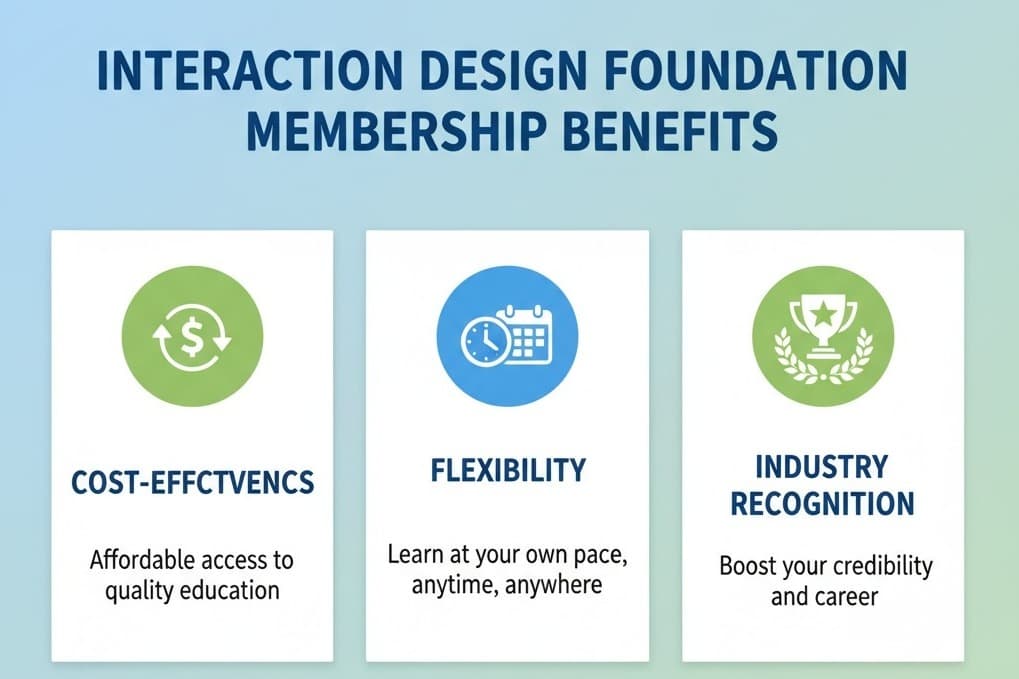
Cost: IxDF membership is far more affordable than both bootcamps and formal degrees, which is essential for continuous professional learning and team-wide upskilling.
Credibility: Content is authored and peer-reviewed by renowned leaders such as Don Norman and industry veterans from major product teams. Maintaining this high standard, the IxDF is recognized by major organizations, as highlighted by authoritative resources like Nielsen Norman Group.
Flexibility: Self-paced courses enable senior designers, UX managers, and product leads to fit targeted skill development into their stricter schedules. This is vital for those handling complex workloads, as discussed in depth in the EngiDes page.

With IxDF, you pay a flat yearly fee rather than per course. This distinction is crucial, especially for organizations executing large projects or ongoing professional development. Compare this to platforms such as Coursera or Udemy, where pricing scales with course volume and specialization.
Here is a breakdown of typical IxDF membership tiers (details may vary by region):
Membership Type | Who It Is For | Key Benefits |
Professional | Individual designers | Access to all courses, certificates, and global expert community. |
Student | Currently enrolled students | Discounted rate with full library access. |
Design League | Those wanting coaching | Personalized coaching and portfolio reviews with veteran designers. |
This all-access model is ideal for professionals committed to lifelong learning. Once subscribed, you’re incentivized to master both foundational and advanced structural foundation design topics.
Content quality is paramount for expert growth. Thankfully, the Interaction Design Foundation boasts a curriculum grounded in academic rigor and real-world practice.
The courses skew toward comprehensive reading and case-based learning, aligned with standards found in leading university programs and echoed by global professional bodies. They are comparable to resources recommended by the Interaction Design Association (IxDA).
Unlike many bootcamps or training centers that emphasize tool proficiency (e.g., Figma, Sketch), the IxDF curriculum is grounded in theory, covering the critical “why” that underpins robust digital systems:
Pros: Empowers design leaders to build frameworks for scalable problem solving and evidence-based user research.
Cons: May require supplemental, practice-oriented workshops for hands-on software mastery. For a practical angle, refer to advanced methodology posts on engides.com.
Advanced practitioners often pair IxDF courses with targeted workshops or collaborative design sprints highlighted in Google’s Material Design external documentation to ensure a holistic growth trajectory.
Navigating a vast curriculum can be daunting, especially for experts seeking tailored progression paths. Here are several standout courses that lay a solid interactive design foundation for advanced roles:
Design Thinking: The Beginner’s Guide: Essential for anyone leading innovation programs or strategic workshops.
Human-Computer Interaction (HCI): For senior designers involved in systems engineering or pioneering new interface paradigms.
UX Management: Suited for UX leads managing cross-functional teams and crafting scalable, user-driven processes.
You can explore the full course catalog at the Interaction Design Foundation website for niche specializations aligned with your interests.
For additional in-depth content on design system management and enterprise innovation, explore relevant expert posts on engides.com’s blog.
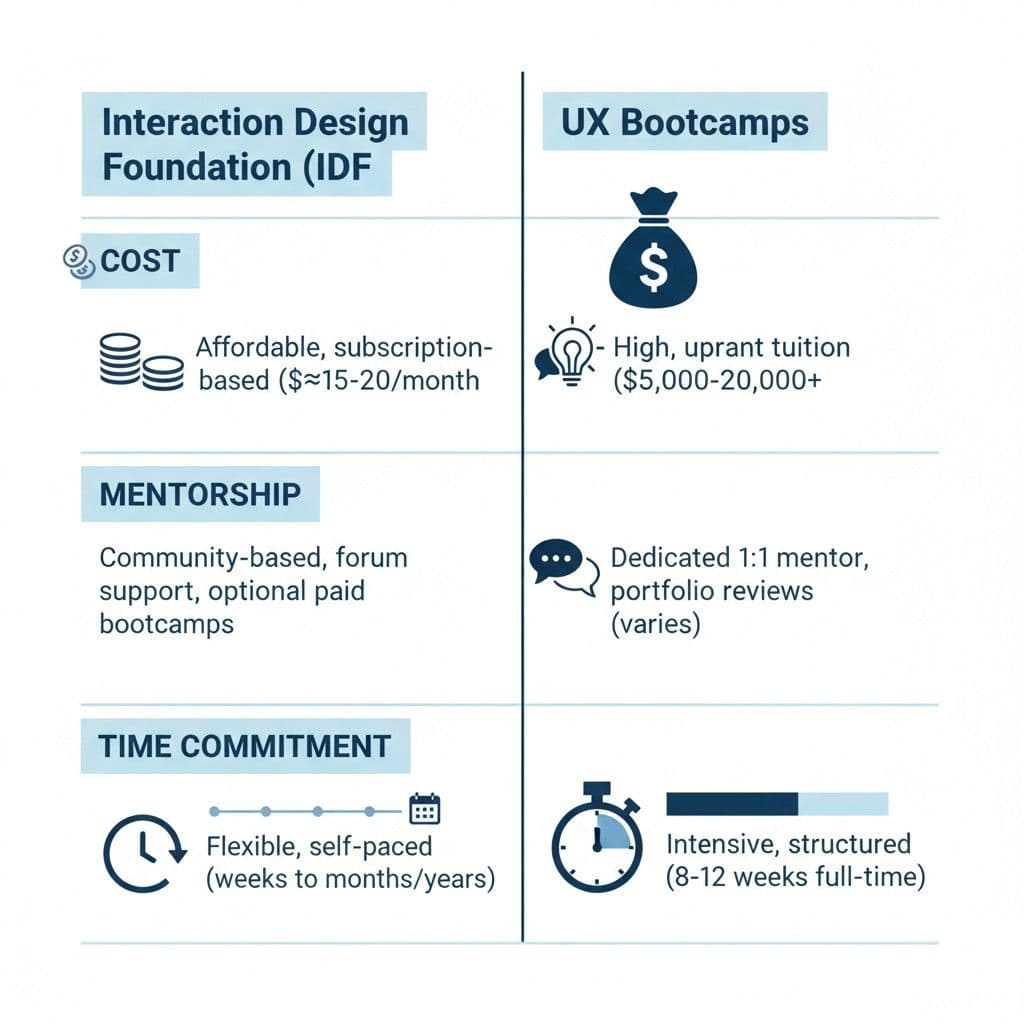
How does IxDF compare to intensive UX bootcamps, especially from an expert's perspective? Let’s consider a detailed feature comparison relevant to senior professionals and decision-makers:
Feature | Interaction Design Foundation | Typical UX Bootcamp |
Cost | ~$200/year (approx.) | $8,000 - $15,000 |
Time Commitment | Self-paced (asynchronous) | Intensive (3-6 months, full time) |
Mentorship | Limited, scalable via community | High-touch, personalized 1-on-1 |
Job Guarantee | None | Sometimes, with caveats |
Portfolio Output | Certificates, case-work (self-built) | Structured, guided portfolio projects |
Expert Verdict: Discerning professionals find the IxDF provides robust theoretical grounding and flexibility to keep current with emerging research. For those driving innovation or mentoring in-house talent, a platform like IxDF represents a scalable training investment. Yet, if your team requires guided job placement or intensive portfolio grooming, a bootcamp (analyzed more on EngiDes services) may be more suitable.
For a comprehensive industry overview, see the reputable summary on the Bureau of Labor Statistics’ web design career page.
Do employers especially those recruiting at a high level value IxDF credentials? The nuanced answer: they provide demonstrable validation of knowledge, but senior hiring decisions are driven by demonstrable outcomes.
Having an Interaction Design Foundation certificate signals breadth and currency with global UX best practices. It demonstrates the commitment to, and mastery of, foundational concepts and advanced frameworks a mark appreciated in thought-leadership roles. However, for architects and directors, strategic portfolios, cross-functional leadership, and project impact weigh more heavily.
Another key benefit for advanced professionals: IxDF’s international community and robust chapter network. Engaging in these networks virtual or in-person facilitates peer review, collaboration, and thought leadership opportunities that are invaluable for career advancement.
Search interest in foundation design can create confusion between digital and structural engineering domains. While a structural foundation design supports physical buildings, in digital product strategy, “foundation design” refers to the core principles that sustain scalable user experiences.
Expert teams often bridge these disciplines. For resources on merging UX frameworks with architectural thinking, refer to the authoritative World Wide Web Consortium’s guide to web accessibility.
Just as a robust pier and beam foundation design or well-engineered retaining wall foundation design creates safety and longevity in construction, thorough research and iterative user testing underpin resilient digital solutions.
There is no single global accreditation body for design practice. Certifications like IxDF’s signal community standing and commitment to lifelong learning, rather than regulatory compliance.
However, IxDF’s recognition by major design employers such as IBM, Adobe, and SAP, as verified on their official About page, reinforces its position as a leading non-university certification. For those seeking to understand formal pathways in adjacent disciplines, the engides.com knowledge center offers comparative studies of certification standards across digital and structural domains.
To make this super clear, let's look at the good and the bad.
Affordable: It is the best "bang for your buck" in design education.
Trusted: Recognized by industry leaders.
Comprehensive: Covers everything from psychology to visual design.
Self-Paced: No deadlines to stress you out.
Reading-Heavy: Can be boring if you are a visual learner.
Lack of Feedback: Unless you pay extra, nobody grades your work deeply.
Not a Portfolio Builder: You have to do the extra work yourself to turn lessons into portfolio pieces.
We recommend the Interaction Design Foundation for:
Career Switchers: People dipping their toes into UX without spending thousands.
Marketing/Product Pros: People who work with designers and want to understand their language.
Junior Designers: Those who know the tools but lack the theoretical knowledge to defend their design decisions.
If you are looking for a designer lift foundation to elevate your skills from junior to mid-level, this is a fantastic resource.
Don't just sign up blindly. Have a plan.
Audit your skills: What are you missing? Research? UI? Strategy?
Check the catalog: Does IxDF cover those gaps?
Set a schedule: Since it is self-paced, you need to block out time on your calendar, or you will never finish.
If you are interested in broader engineering or design structures, you might even look into how physical foundations work, like retaining wall foundation design, to see how structural integrity applies across different engineering disciplines. The concept is always the same: strong bases make strong products.

The Interaction Design Foundation is an excellent resource, but it is not a magic pill. It provides the raw knowledge you need to succeed, but it requires you to put in the effort to apply that knowledge. It is perfect for disciplined learners who value depth over flashiness.
If you are ready to commit to reading, learning, and applying these principles, an IxDF membership is likely the best investment you can make for your career this year. It connects you to a global community and gives you the vocabulary to speak like a pro.
If you are looking to expand your technical knowledge further or explore engineering design concepts, check out engides.com for more in-depth articles and resources.
Cost-Effective: IxDF is significantly cheaper than bootcamps or degrees, operating on a yearly membership model.
Theory-First: The curriculum focuses on design principles, psychology, and research rather than just software tools.
Industry Respected: While not a university degree, the certifications are recognized by major tech companies.
Self-Discipline Required: Because it is self-paced and reading-heavy, you need to be motivated to finish courses.
Not a Portfolio Replacement: You must take the initiative to turn course assignments into portfolio case studies to get hired.
 Engides